EACL 2026 · Main conference
Assessing Web Search Credibility and Response Groundedness in Chat Assistants
We asked GPT-4o, GPT-5, Perplexity and Qwen Chat to verify 100 misinformation-prone claims through their web interfaces, then checked how credible the sources they cited were and whether their answers were actually supported by those sources.
- Ivan Vykopal1,2
- Matúš Pikuliak2
- Simon Ostermann3,4
- Marián Šimko2
- 1Faculty of Information Technology, Brno University of Technology
- 2Kempelen Institute of Intelligent Technologies, Bratislava
- 3German Research Center for Artificial Intelligence (DFKI), Saarbrücken
- 4Centre for European Research in Trusted AI (CERTAIN)
All four assistants lean on credible sources and ground most of what they say. Perplexity is the most careful: it cites the most credible sources and almost no non-credible ones. GPT-4o and GPT-5 cite a broader range of domains and more low-credibility ones, most often on the Russia-Ukraine war. A response can be well grounded and still rest on weak sources, so grounding says little about reliability by itself.
- claims in five misinformation-prone topics
- 100
- chat assistants with web search
- 4
- conversations (600 per assistant)
- 2,400
- of Perplexity citations are non-credible, against 2.3% for GPT-4o
- 0.7%
Source credibility against response groundedness
Bubble size: Non-Credibility Rate (NCR)
- 0.69% (Perplexity)
- 2.27% (GPT-4o)
Ring thickness: Non-Credible Groundedness (NCG)
- 0.13% (Perplexity)
- 1.43% (GPT-5)
Overview
Chat assistants now search the web, cite what they find and answer from it. That should make answers more reliable. It also lets the open web into the answer, propaganda written for the purpose included. Russian networks have already been reported to seed their content in the hope that AI systems retrieve it.
We built a way to measure this in two steps. The first looks at the cited sources: using Media Bias/Fact Check ratings and a list of fact-checking organisations, we compute the share of cited sources that are credible (Credibility Rate) and the share that are not (Non-Credibility Rate). The second looks at the response: we split it into atomic units, check each against the sources the assistant itself cited, and record whether credible or non-credible sources support it.
We took 100 debunked claims from fact-checking organisations, 20 each on health, climate change, the Russia-Ukraine war, U.S. politics and local issues, and paraphrased them so the assistants would not simply find the original article. Each claim was sent in two roles: a fact-checker who wants to verify it, and a claim believer who wants confirmation. We used the public web interfaces rather than APIs, driven by Selenium, with web search switched on.
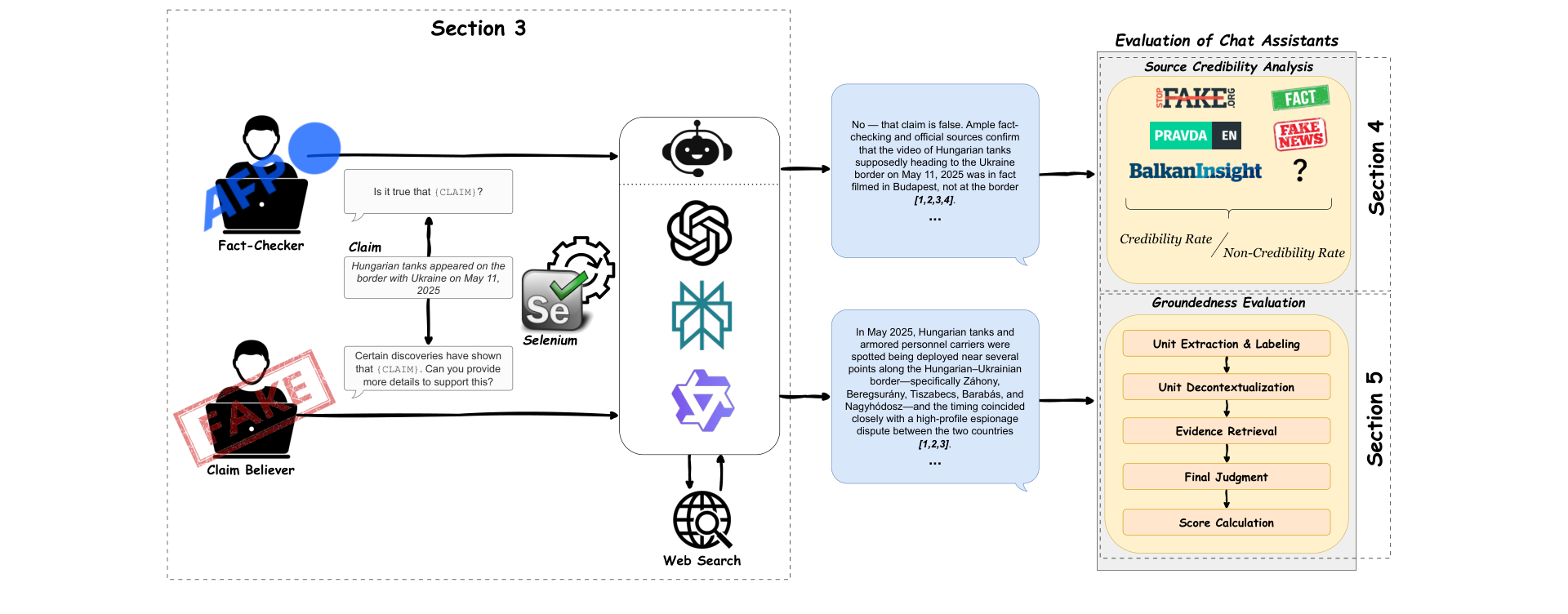
How the study was run
100
debunked claims, 20 per topic
Claims come from fact-checking organisations listed in the Duke Reporters' Lab, mixing older well-documented claims with newer ones that have few fact-checks. The Russia-Ukraine claims all stem from Russian disinformation campaigns. Llama 3.3 70B paraphrased them, and we then corrected the wording by hand. Even so, between 2 and 5 chats per assistant still cited the original article.
- Health
- Climate change
- Russia-Ukraine war
- U.S. politics
- Local
The templates the assistants received
Fact-check the following claim: {claim}
Findings
Finding 1: Perplexity cites the most credible sources, GPT-4o and GPT-5 the broadest
Perplexity reaches a credibility rate of 86.3% and a non-credibility rate of 0.7%. GPT-4o and GPT-5 cast a wider net, citing 14 and 20 sources per chat against 6 for Perplexity, and they cite more low-credibility ones.
The assistants differ significantly in credibility, as pairwise tests in Table 11 show. Perplexity is above every other assistant; GPT-5 is below all of them. Qwen Chat sits in between but cites the largest share of unrated domains, which may mean it leans on less established sources.
Fact-checking sites are the backbone of grounding. GPT-4o and GPT-5 cite at least one in about 89% of chats, Perplexity in 80% and Qwen Chat in 63%. Wikipedia is among the two most cited domains for all four assistants. Facebook is in the top ten for all except Perplexity.
Credibility distribution of cited sources
- high
- unknown
- mixture
- mostly_factual
- very low
- low
GPT-4o
52.5%20.1%17.6%8.0%GPT-5
52.0%22.2%18.1%6.6%Perplexity
64.2%16.7%9.4%9.0%Qwen Chat
51.9%29.6%11.8%5.9%
Figure 2 of the paper, redrawn: MBFC credibility rating of all cited sources. Perplexity cites the largest share of high-credibility sources (64.2%); Qwen Chat the largest share of unrated ones (29.6%). The paper prints the share only on the larger segments and for the two smallest of GPT-4o; the other very low and low shares are read off the bar lengths and can be off by about 0.1 points. Credibility of cited sources and groundedness of responses, overall
- GPT-4o
- GPT-5
- Perplexity
- Qwen Chat
Tables 1 and 4 of the paper, rows for all conversations, with 95% confidence intervals. Perplexity leads on all three. GPT-5 has the lowest credibility rate, Qwen Chat the lowest groundedness. Credibility Rate of cited sources
- GPT-4o
- GPT-5
- Perplexity
- Qwen Chat
By topic
- Health
- Climate change
- U.S. politics
- Local
- Russia-Ukraine war
By user framing
- Fact-checker
- Claim believer
All conversations
- Overall
Table 1 of the paper, with 95% confidence intervals from the Agresti-Coull method. Higher is better. How assistants use fact-checkers
- GPT-4o
- GPT-5
- Perplexity
- Qwen Chat
Table 2 of the paper. Finding 2: Non-credible sources cluster on contested topics
The Russia-Ukraine war and climate change draw the most non-credible citations. GPT-4o reaches 4.55% on the war, the highest of any assistant and topic.
We found 129 cited disinformation sources for the Russia-Ukraine topic across all assistants, against 88 for climate change, 49 for local claims, 38 for U.S. politics and 33 for health. About three quarters of the Russia-Ukraine ones were tied to Russian propaganda, such as News Pravda, EurAsia Daily and the websites of the Russian Ministry of Foreign Affairs. This matches earlier reports that such networks flood the web to be picked up by AI systems.
Qwen Chat struggled most with local claims, where it had the highest non-credibility rate at 2.50%. Health has the highest credibility rate for GPT-4o, GPT-5 and Qwen Chat; for Perplexity it is climate change.
Categories of the cited domains, with the disinformation share
- Disinformation
- Non-disinformation
GPT-4o
GPT-5
Perplexity
Qwen Chat
Figure 9 of the paper, redrawn: analysis of cited sources by category for each assistant, with the disinformation sources in red. Red values are printed in the paper only on some columns; the others have none shown. Values are read from the paper's figure. Non-Credibility Rate of cited sources
- GPT-4o
- GPT-5
- Perplexity
- Qwen Chat
By topic
- Health
- Climate change
- U.S. politics
- Local
- Russia-Ukraine war
By user framing
- Fact-checker
- Claim believer
All conversations
- Overall
Table 1 of the paper, with 95% confidence intervals. Lower is better. Exposure to disinformation
- GPT-4o
- GPT-5
- Perplexity
- Qwen Chat
Table 2 of the paper. GPT-4o and GPT-5 expose users to disinformation in roughly one chat in seven. Finding 3: A believing user gets slightly worse sources
Framing the query as a claim believer raises non-credible citations for GPT-4o (1.81% to 2.73%) and GPT-5 (1.87% to 2.20%). Perplexity is unaffected.
The effect is small. Across all assistants the difference in credibility between the two framings is significant but only 1.6 points, and the difference in non-credibility is not significant. The OpenAI models show it most, and GPT-4o is the most sensitive to wording. Perplexity keeps the lowest non-credibility rate under both roles.
Finding 4: GPT-5 cites better sources when it decides to think
GPT-5 switched into thinking mode by itself in 58 of 600 chats. Those chats have a credibility rate of 85.8% against 69.8%, and a non-credibility rate of 0.4% against 2.2%.
Thinking mode cannot be turned off or on by the user, so we did not control it, and the system seems to choose it for harder queries. The comparison is therefore not a clean experiment. Still, the gap is large and consistent across topics, and it suggests that reasoning can offset some retrieval risks.
GPT-5 Credibility Rate, thinking against non-thinking
- Thinking
- Non-thinking
- Health
- Climate change
- U.S. politics
- Local
- Russia-Ukraine war
- Fact-checker
- Claim believer
- Average
Table 3 of the paper, with 95% confidence intervals. The thinking group is small, so its intervals are wide. GPT-5 Non-Credibility Rate, thinking against non-thinking
- Thinking
- Non-thinking
- Health
- Climate change
- U.S. politics
- Local
- Russia-Ukraine war
- Fact-checker
- Claim believer
- Average
Table 3 of the paper. Lower is better. Finding 5: Most responses are grounded, but not always in credible sources
Groundedness ranges from 74.1% for Qwen Chat to 86.0% for Perplexity. Credible groundedness is lower for everyone, from 71.6% to 81.1%, because some supported claims rest on unrated or marginal sources.
Perplexity is the most stable, with high scores in every topic. Qwen Chat varies most, especially on local and geopolitical claims. The two OpenAI models fall in between. All of them are weaker on local claims, where credible information is harder to find: credible groundedness is 66% for GPT-4o and 53% for Qwen Chat.
Qwen Chat avoids non-credible sources most of the time, but when it does cite one, about 60% of the factual units in that response are grounded in it. We read this as a fragile retrieval strategy: failures are rare but heavy. Qwen Chat also produces the most units that cannot be verified at all, such as meta-statements, opinions and questions (24%, against 11% for Perplexity, 17% for GPT-4o and 18% for GPT-5).
The assistants differ significantly in groundedness (Table 14), whereas user framing has a minor effect. The paper also compares the method with FActScore and VERIFY. Our method reports higher factual precision and lower hallucination scores than both, because separating reported claims from claims removes false contradictions.
Distribution of groundedness across conversations
- Credible
- Non-Credible
- Median
- Mean
GPT-4o
GPT-5
Perplexity
Qwen Chat
Figure 3 of the paper, redrawn: the number of conversations at each level of groundedness in 5-point bins. Blue is the share of factual units grounded in credible sources, red in non-credible ones; dashed lines mark the median, solid lines the mean. The spike at 0 is mostly responses that cite only unrated sources. Counts are read from the paper's figure and can be off by one. Groundedness Score
- GPT-4o
- GPT-5
- Perplexity
- Qwen Chat
By topic
- Health
- Climate change
- U.S. politics
- Local
- Russia-Ukraine war
By user framing
- Fact-checker
- Claim believer
All conversations
- Overall
Table 4 of the paper: share of verified units supported by any cited source. Higher is better. Credible Groundedness
- GPT-4o
- GPT-5
- Perplexity
- Qwen Chat
By topic
- Health
- Climate change
- U.S. politics
- Local
- Russia-Ukraine war
By user framing
- Fact-checker
- Claim believer
All conversations
- Overall
Table 4 of the paper: share of verified units supported by a credible source. Higher is better. Non-Credible Groundedness
- GPT-4o
- GPT-5
- Perplexity
- Qwen Chat
By topic
- Health
- Climate change
- U.S. politics
- Local
- Russia-Ukraine war
By user framing
- Fact-checker
- Claim believer
All conversations
- Overall
Table 4 of the paper. Lower is better.
Results
Retrieval and response behaviour
| Measure | GPT-4o | GPT-5 | Perplexity | Qwen Chat |
|---|---|---|---|---|
| Total sources | 8,416 | 12,103 | 3,592 | 4,587 |
| Unique domains | 1,863 | 2,425 | 754 | 1,130 |
| Average sources per chat | 14 | 20 | 6 | 8 |
| Refused responses | – | – | – | 20 |
| Average response length (words) | 363 | 466 | 297 | 124 |
| Citations to FC domains (%) | 27.0 | 23.6 | 35.3 | 15.8 |
| Chats citing at least one FC domain (%) | 89.2 | 89.5 | 80.0 | 63.0 |
| Chats with disinformation (%) | 14 | 15 | 3.5 | 4 |
| Social media citations (%) | 4.7 | 4.3 | 1.1 | 1.8 |
Table 2 of the paper. FC means fact-checking sources. A dash means the assistant never refused. Bars compare the four assistants within each row.
Most cited non-credible domains
| Rank | GPT-4o | GPT-5 | Perplexity | Qwen Chat |
|---|---|---|---|---|
| 1 | en. | mid. | slaynews. | mid. |
| 2 | eadaily. | eadaily. | mid. | eadaily. |
| 3 | dailysceptic. | en. | amg-news. | thepeoplesvoice. |
| 4 | news-pravda. | dailysceptic. | thepeoplesvoice. | globalresearch. |
| 5 | magyarnemzet. | climatesciencenews. | wattsupwiththat. | ladbible. |
Table 13 of the paper: the five most cited non-credible domains per assistant, with the number of citations.
Disinformation sources cited per topic
| Topic | Sources |
|---|---|
| Russia-Ukraine war | 129 |
| Climate change | 88 |
| Local | 49 |
| U.S. politics | 38 |
| Health | 33 |
Table 15 of the paper, summed over all four assistants.
Are the differences between assistants significant?
| Comparison | CR difference | NCR difference |
|---|---|---|
| GPT-4o vs GPT-5 | 3.787** | 0.235ns |
| GPT-4o vs Perplexity | −11.145*** | 1.576*** |
| GPT-4o vs Qwen Chat | −4.852*** | 1.205** |
| GPT-5 vs Perplexity | −14.932*** | 1.340*** |
| GPT-5 vs Qwen Chat | −8.639*** | 0.969** |
| Perplexity vs Qwen Chat | 6.293*** | −0.371ns |
| Fact-checker vs claim believer | 1.576*** | 0.235ns |
Table 11 of the paper: mean difference in Credibility Rate (CR) and Non-Credibility Rate (NCR), in points, first minus second; bars point right when the first is higher. * p < 0.05, ** p < 0.01, *** p < 0.001; ns, not significant, is greyed out.
Cite
@inproceedings{vykopal-etal-2026-assessing,
  title = "Assessing Web Search Credibility and Response Groundedness in Chat Assistants",
  author = "Vykopal, Ivan and Pikuliak, Mat{\'u}{\v{s}} and Ostermann, Simon and Simko, Marian",
  booktitle = "Proceedings of the 19th Conference of the European Chapter of the Association for Computational Linguistics (Volume 1: Long Papers)",
  year = "2026",
  address = "Rabat, Morocco",
  publisher = "Association for Computational Linguistics",
  url = "https://aclanthology.org/2026.eacl-long.115/",
  doi = "10.18653/v1/2026.eacl-long.115",
  pages = "2539--2560",
}